 High Frequency MeasurementsWeb Page
Douglas C. Smith Address: P. O. Box 1457, Los Gatos,CA 95031
TEL: 800-323-3956/408-356-4186
FAX: 408-358-3799
Mobile: 408-858-4528
URL: www.dsmith.org
Email: doug@dsmith.org
Technical Tidbit - August 2003
Sin(x)/x, the Forgotten Setting - Part One 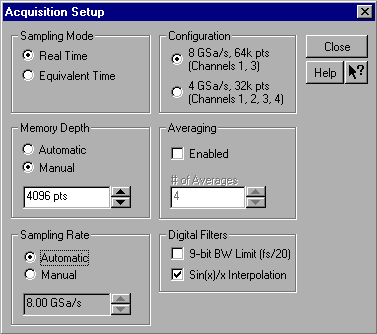
Figure 1. Acquisition Setup for Scope
Abstract: Digitizing oscilloscopes have many settings that affectthe accuracy of measurements. One of these settings is Sin(x)/x interpolation.The effect of this setting on the display is discussed. For many measurements,this feature should be disabled.
Discussion: Figure 1 shows the menu for signal acquisition in an Agilent 54845adigitizing oscilloscope. The Sin(x)/x interpolation option is easy to overlook. Sin(x)/x interpolation is used to smootha digital waveform display. Often the waveform is more pleasing tolook at with this interpolation enabled, but it can hide the fact that a single shotwaveform may not be displayed accurately.
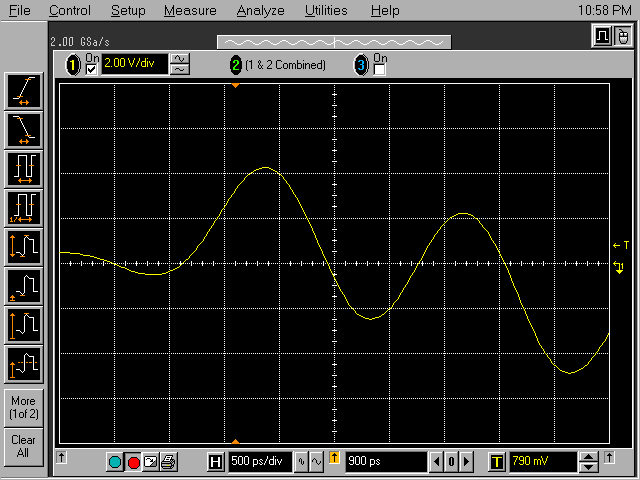
Figure 2 shows a waveform displayed with Sin(x)/x interpolation enabled.Notice that the time scale is 500 ps/div and yet the sample rate (displayedin the upper left above the waveform) is only 2 GSa/sec (gigasamples/second).The scope is capable of much faster sampling, but for this example the samplingrate has been slowed down to a rate similar to many digitizing scopes nowin use. A sampling rate of 2 GSa/sec yields a sample every 500 ps sothere is only one sample per horizontal division of the display, but onewould never guess this to be the case from the smooth waveform in Figure 2.
Figure 2. Waveform With Sin(x)/x On
(500 ps/div)
Figure 3 shows the same waveform with Sin(x)/x interpolation turned off. There is quite a difference compared to Figure 2. The individual samples,one per horizontal division, can be seen connected by straight lines. Thesharp corners in the waveform show that the sampling rate is not nearly fastenough to properly display this waveform. In fact, it cannot be known whathappens to the waveform between samples. The waveform could (and does, inthis case) contain oscillations between the samples that cannot be seen. Thiseffect of under sampling is often called aliasing and the waveform is referredto as aliased.
Figure 3. Waveform With Sin(x)/x Off
(500 ps/div)
For many uses, I prefer to disable Sin(x)/x interpolation to avoid hidingsampling problems such as shown above. This is especially important as manyforms of EMI, like electrostatic discharge, can produce very fast waveformsand signals on circuit boards get faster with each new generation of hardware.
Summary and Conclusion: Use of Sin(x)/x interpolation can hidethe fact that the sampling rate used is not fast enough to display a waveform.In many cases, it should be disabled to insure an accurate measurement.
Equipment used in this article include:
Top of page
Home
Questions or suggestions? Contact me at doug@dsmith.orgCopyright © 2003 Douglas C. Smith